
Shipping Chokepoints 2026: The Red Sea's Fragile Return
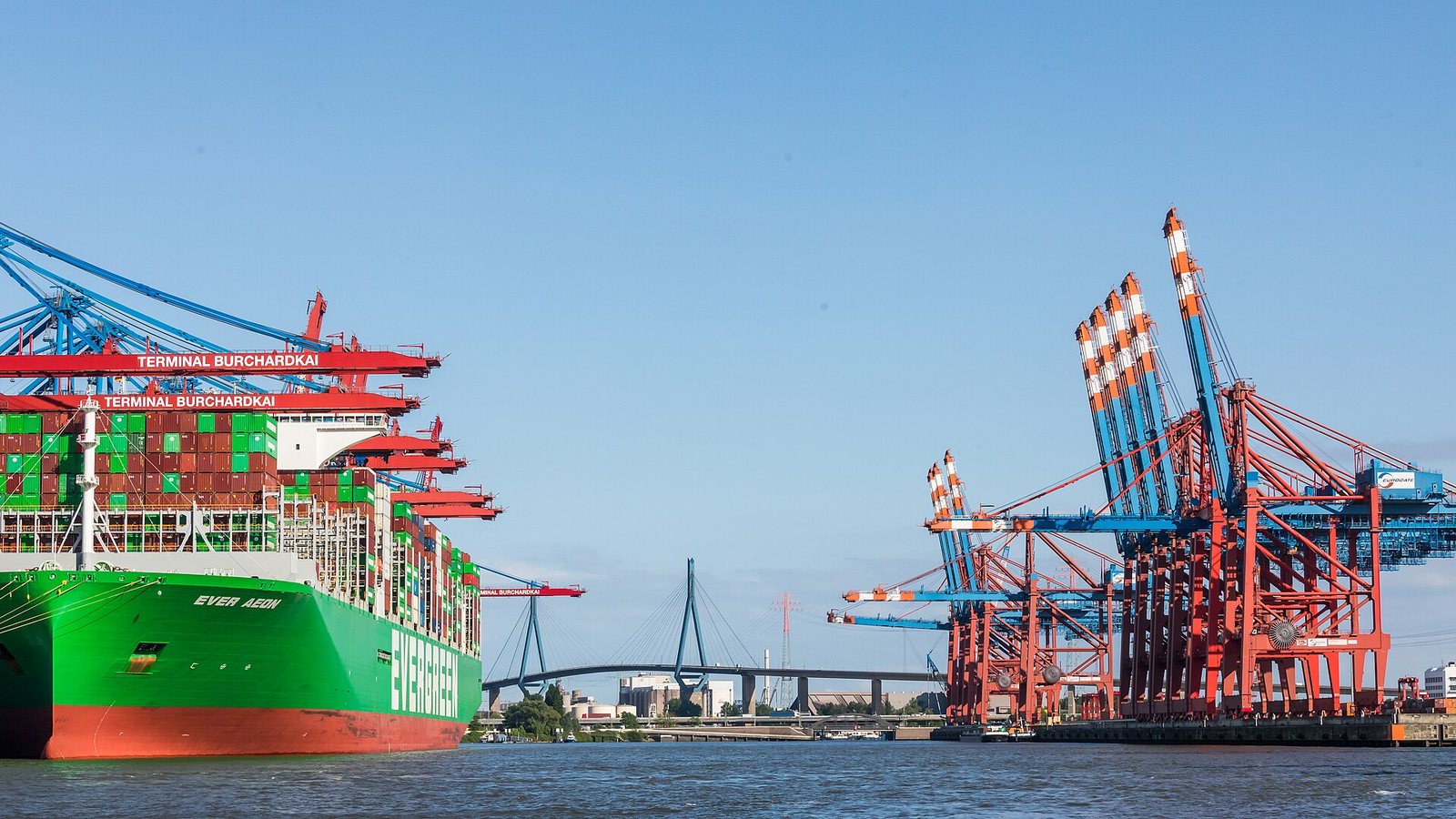
Photo: Container ship Ever Aeon at Container Terminal Burchardkai, Hamburg — Raimond Spekking / Wikimedia Commons, CC BY-SA 4.0
On 26 October the Suez Canal Authority met twenty shipping lines in Ismailia to discuss schedules. The meeting was routine; the reason was not. Three years after the Red Sea crisis sent the world’s container fleet around Africa, the principal east–west corridor is reopening — and its arithmetic is the clearest read yet on how the global trading order is being re-priced. Diversion, war-risk premia and voyages ten to fourteen days longer are unwinding into an unchanged security environment.
Why Shipping Chokepoints 2026 Look Nothing Like 2023
In late 2023 the story was closure: weekly container capacity through Suez collapsed to about 330,000 TEU from a 2023 norm near 1.457 million, and through mid-2026 averaged 141,000 TEU, about 11 percent of 2023 (BIMCO). Today the corridor reopens while the conflict continues, and while Panama’s water and the carbon bill tighten.
Suez: Halfway Back, Measured in TEU
Weekly container capacity transiting Suez averaged 753,000 TEU in the first two weeks of October — the first time since the diversions that it has passed half the pre-crisis level, roughly 52 percent of 2023’s 1.457 million TEU weekly average. Of all capacity routed through the canal or the Cape, 36 percent now uses it, against 8 percent through mid-2026 and about 80 percent before.
Composition matters more than the total. Lloyd’s List Intelligence counts over one hundred containerships of 16,000 TEU and above through the canal since September began — more than the 99 in all of 2025 and the first eight months of 2026 combined. Only eight made the passage in 2025; in October’s first twenty days such ships were half of boxship capacity through the canal. Alphaliner puts 63 percent of direct Asia–Europe capacity on Red Sea loops. September’s 2.2 million TEU sits against 6 million before the crisis, and Egypt’s fiscal 2025/26 revenue of US$4.67 billion, up 23 percent, compares with US$10.2 billion in 2023.
Bab el-Mandeb: An Open Route Without a Settlement
The corridor is reopening faster than the war around it is settling. Houthi forces seized Perim Island in September; Saudi-backed forces retook key ground near Bab el-Mandeb in early October, after which the Houthis shifted to strikes on Saudi airports and energy infrastructure, killing at least twenty people. On 20 October EU foreign policy chief Kaja Kallas told the European Parliament that member states must turn pledged naval commitments into ships at sea, conceding that Aspides cannot escort every vessel that asks.
Insurance is where this becomes a price. London’s Joint War Committee extended its southern Red Sea listed area north from 18°N to 25.5°N in JWLA-034, taking in Jeddah and Yanbu. Indicative premiums moved from 0.3 percent of hull value to about 0.75 percent within days, then above 1 percent; by late September quotes for Saudi-linked tankers at Yanbu were near 3 percent, against 0.2 to 0.3 percent for unconnected tonnage. On a US$100 million hull, one percentage point is a million dollars a transit — which is why the return is incremental.
Panama: A Record Year Under Water Stress
The other interoceanic shortcut closed its fiscal year on a record. The Panama Canal Authority reported 13,951 transits to 30 September, up 4.1 percent, and 521 million PC/UMS tons, up 6.5 percent, beating fiscal 2022’s 518.8 million. Revenue reached B/.6.6 billion, up 16.6 percent, despite May–August rainfall 34 percent below average. Since 15 October the Neopanamax locks have handled ten transits daily, for 33 combined. A water deficit persists.
The Corridors Side by Side
None is fully normal; none is fully closed.
| Corridor or regime | Latest reading (Oct 2026) | Versus pre-crisis norm | Binding constraint |
|---|---|---|---|
| Suez Canal | 753,000 TEU/week container capacity, first two weeks of October | ~52% of the 1.457m TEU weekly 2023 level | Security in the southern Red Sea |
| Bab el-Mandeb | Formally disrupted; JWC listed area extended north to 25.5°N | 36% of canal-or-Cape capacity uses Suez, against ~80% before | Houthi–Saudi exchange; war-risk pricing |
| Strait of Hormuz | Gulf ports served through landbridges and feeders | Transit traffic fell by around 95% in the early conflict | Iran conflict; no settled passage regime |
| Panama Canal | Record 521m PC/UMS tons in FY2026; 33 daily slots | Above the FY2022 record of 518.8m tons | El Niño water deficit; 34% rainfall shortfall |
| Cape of Good Hope | Residual diversions lowest since January 2024 | Adds 10–14 days and roughly 10% to fleet demand | Cost, not closure |
| IMO Net-Zero Framework | Adoption decision due 4 December 2026 | Would be the first global carbon price on a whole sector | Political agreement among member states |
Capacity returns faster than confidence: a loop can be restored in a week; certainty about a strait cannot.
Freight Rates: A Thirteen-Week Slide Ends
The price effect inverted the usual logic of disruption. Asia–Europe spot rates fell thirteen consecutive weeks as returning tonnage shortened voyages and released capacity. Drewry’s World Container Index then rose 3 percent to US$4,485 per 40ft on 15 October, Rotterdam up 6 percent to US$3,522, Genoa up 7 percent to US$3,945. Carriers filed Asia–Europe increases of US$4,500–4,800 per 40ft from 19 October, but with returning Suez capacity Drewry judges implementation uncertain.
The December Carbon Decision
One regulatory variable will set what this costs after 2027. The IMO Net-Zero Framework, approved at MEPC 83 in April 2025, was adjourned that October rather than adopted; MEPC 84 set a route back. ISWG-GHG 23 meets 23–27 November, MEPC 85 runs 30 November–3 December, and the extraordinary session resumes on 4 December. As drafted, it would cover ships of 5,000 gross tonnage and above on international voyages — over 85 percent of the sector’s emissions — against a 2008 reference of 93.3 gCO2e/MJ, with a base target cutting 4 percent by 2028 and 30 percent by 2035, and a direct compliance target cutting 17 and 43 percent. Deficits would be settled with remedial units at US$100 per tonne of CO2 equivalent, or US$380 above the base target. Entry into force could follow by March 2028. Unlike the European Union’s Emissions Trading System, which reaches voyages touching EU ports from 2026, the IMO measure would reach transpacific and intra-Asia lanes. For shipping chokepoints 2026, that is the difference that matters: a global price, not a regional one.
What Would Reverse the Recovery?
Geopolitics decides the next two quarters. Security comes first: a strike on a transiting boxship would re-price insurance within days, which is why carriers hedge by routing westbound through Suez and eastbound around the Cape. Sanctions and export controls now sit alongside war risk in one underwriting file, and customs authorities from Washington to Beijing read the same shipping chokepoints 2026 data when drafting supply chain rules. Water is the second, since Panama’s record year came under an unresolved deficit. The 4 December vote is the third, pricing the long voyage just as the short one reopens. Demand is weaker than headline figures suggest: UNCTAD expects global growth to slow to 2.6 percent in 2026 even as trade expands about 4 percent, with China–US trade down over 20 percent since 2024. Chokepoints are no longer priced as occasional risks but continuously. The export-controls brief of 21 October traced how states govern what may cross a border; this week shows the crossing itself has become policy. The archive covers both, including the September 2026 tariff shock.
Sources: Suez Canal Authority (Ahram Online, Daily News Egypt); BIMCO/Clarksons; Lloyd’s List Intelligence; Alphaliner; Drewry WCI; Panama Canal Authority; JWC JWLA-034; Council of the EU 818/26; IMO MEPC 84; UNCTAD TDR 2026.
NEGUP Group publishes a trade brief every week. Talk to us about sourcing, quality control and consolidated logistics.
WhatsApp +86 153 0769 0902