
EUDR Compliance Deadline: Europe's Green Import Gate
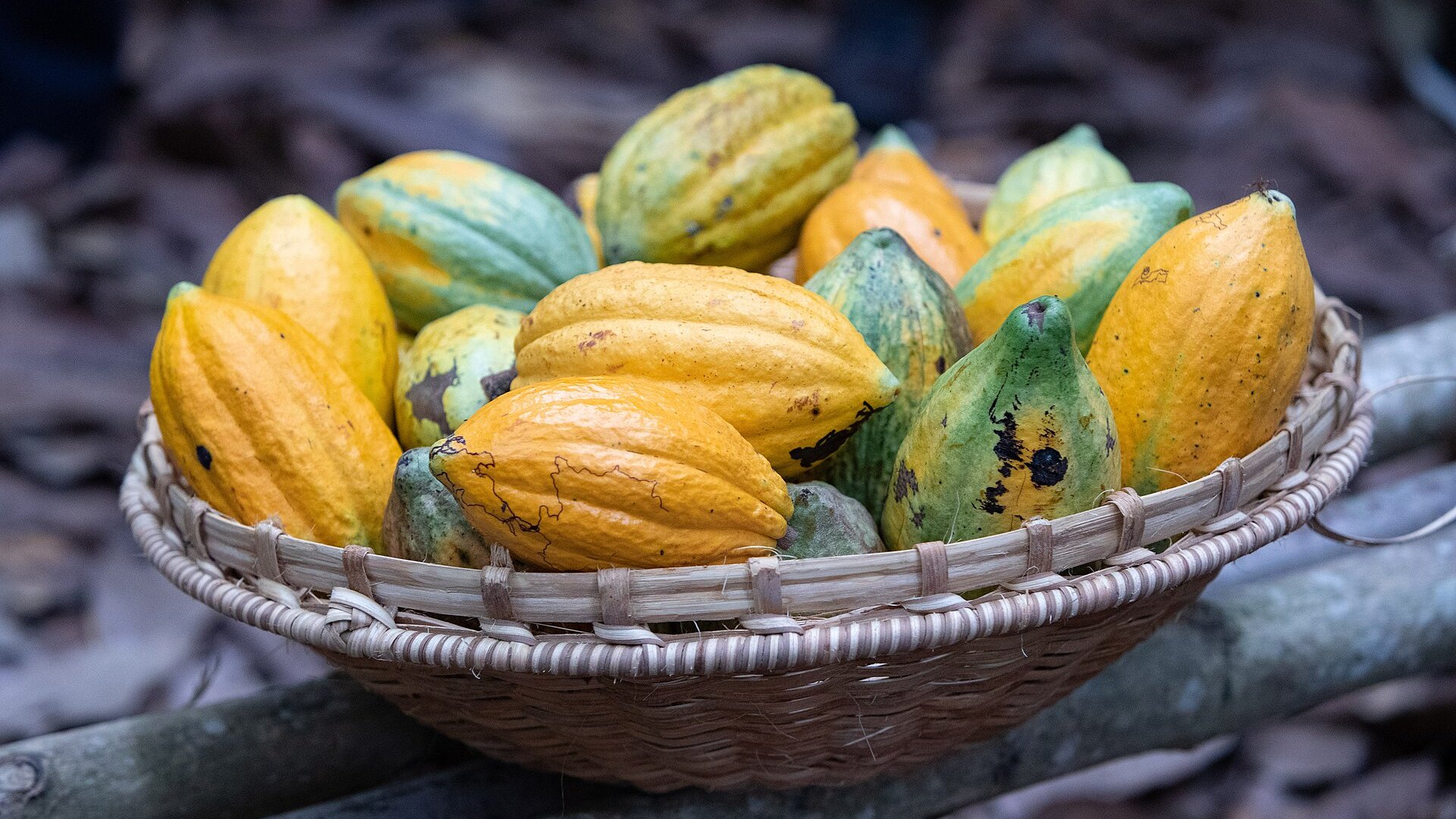
Photo: cocoa pods at harvest in Soubré, Côte d'Ivoire — Milequem Diarassouba / Wikimedia Commons, CC BY-SA 4.0
The European Union's deforestation rules stopped being a Brussels argument this month and became customs machinery. From 15 October 2026, every due diligence statement filed under the EU Deforestation Regulation (EUDR) must be routed to the national competent authority of the member state where the operator is registered — a technical change introduced by Implementing Regulation (EU) 2026/1565, and the last switch to be flipped before the law actually bites. Large and medium operators have to comply from 30 December 2026. Our trade-brief archive follows how market-access rules like this redraw food and agricultural trade.
Two Dates, and One That Is Now Fixed
The December date has survived two postponements and is now written into law: Regulation (EU) 2025/2650 set 30 December 2026 for large and medium operators, with most micro and small enterprises following on 30 June 2027. Micro and small timber businesses already under the older EU Timber Regulation are pulled in on the earlier date. In a report adopted on 4 May 2026 (COM(2026) 191), the Commission said it saw no case for further amendments to the basic legal text. Products newly added to the scope — soluble coffee, palm-oil derivatives and frozen cattle tongues — get an extra year, from 30 December 2027. There is no minimum-volume exemption anywhere in the regulation: one container of green coffee is as covered as a thousand.
| Supply-chain role | Applies from | Core obligation |
|---|---|---|
| Large / medium operator (importer, first placer on the EU market) | 30 Dec 2026 | Full due diligence, plot geolocation, DDS filed in the Information System |
| Non-SME downstream operator or trader | 30 Dec 2026 | Register in the Information System, collect DDS reference numbers, keep records 5 years |
| Micro / small downstream operator or trader | 30 Jun 2027 | Keep supplier and customer records; report suspected non-compliance; no registration |
| Micro / small primary producer in a low-risk country | 30 Jun 2027 | One-off simplified declaration; postal address instead of plot geolocation |
| Micro / small operator already covered by the EU Timber Regulation | 30 Dec 2026 | Main deadline applies in full — no SME deferral for timber |
| Non-EU exporter clearing its own goods into the EU | 30 Dec 2026 | Valid EU EORI number plus system registration before lodging a statement |
| Re-importer of goods already placed on the EU market | 30 Dec 2026 | Treated as a downstream operator if the conditions are met — no repeat full due diligence |
| Products added to Annex I (soluble coffee, palm-oil derivatives, soaps, frozen cattle tongues) | 30 Dec 2027 | One year behind the main application date |
What “Deforestation-Free” Actually Requires
Two things must be true of every consignment. The land it came from must not have been deforested after 31 December 2020, and it must have been produced in accordance with the legislation of the country of production. Proving that takes data, not certificates. Operators must hold the geolocation of every plot where the commodity was grown or raised — a polygon above four hectares, a single coordinate point for smaller ones — and file a due diligence statement (DDS) through the Commission's TRACES-based Information System before the goods are placed on the market or exported. The statement reference must be available before the customs declaration is lodged; code C716 signals to the officer that the declaring company holds one. A single statement may cover several shipments until the declared quantity runs out, for at most a year, and records must be kept for five. The rules bind exports leaving the EU as well as imports entering it, Switzerland, the United Kingdom and Norway included.
The Risk Map, and the Fight Over It
Where a commodity comes from decides how much homework is required. Under Implementing Regulation (EU) 2025/1093, adopted in May 2025, four countries sit in the high-risk tier — Belarus, Myanmar, North Korea and Russia — while 140 are classed low risk, among them all 27 member states, the United States, the United Kingdom, China, Japan, India and Vietnam. Around 50 countries, Brazil and Indonesia among them, are standard risk. That map is politically contested. On 9 July 2025 the European Parliament passed, by 373 votes to 289 with 26 abstentions, a motion from MEP Alexander Bernhuber of the EPP urging the Commission to repeal the benchmarking regulation and rebuild it on fresher data, with regional differentiation and a fourth “negligible risk” tier. Eighteen agriculture ministers had written in similar terms two days earlier. The motion is not binding; the list remains in force, with a review promised during 2026.
| Risk tier | Status | Main origins | Authority checks |
|---|---|---|---|
| Low risk | 140 countries | All 27 EU member states, United States, United Kingdom, Canada, China, Japan, Australia, South Africa, India, Vietnam | 1% of operators; simplified due diligence |
| Standard risk | ~50 countries | Brazil, Indonesia, Malaysia, Côte d'Ivoire | 3% of operators; full risk assessment |
| High risk | 4 countries | Belarus, Myanmar, North Korea, Russia | 9% of operators and of volume; heightened scrutiny |
| Contested | Non-binding EP motion, 9 Jul 2025 | EPP sought a fourth “negligible risk” tier; Commission kept the list and reviews it in 2026 | Classification remains in force |
Where the Exposure Sits
The volumes are not marginal. The EU imports roughly 33 million tonnes of soy a year, mostly to feed livestock, largely from Brazil, the United States and Argentina. It is the world's largest coffee market, taking about a third of global green coffee imports, most of it grown by around 12.5 million smallholders, often on plots under two hectares with no digital land record. Côte d'Ivoire and Ghana together supply roughly 60% of the world's cocoa; Indonesia and Malaysia about 85% of its palm oil. Washington's own estimate is that the regulation could touch some US$9 billion of American agricultural exports.
The Compliance Arithmetic
Compliance is cheap per kilo and costly per relationship. Analyses of the simplified package put the cost of compliance on coffee at roughly €0.10–0.50 per kilogram of green beans. Per tonne, mapped cooperative supply chains are estimated at €15–40, while chains running through intermediaries, where farmers must be mapped retroactively, come in at €40–80. Compliance software for an SME-scale operation runs from about €5,000 to €25,000 a year. Low-risk status is not an exemption: buyers still need the plot data, still file a statement, and must show that low-risk material was not mixed with standard-risk goods. Mass balance is expressly ruled out; segregation of known origin is the standard.
What Changed Inside the System in 2026
The plumbing has been rebuilt. The Information System reopened at the end of June 2026 after a rebuild and took release 8.2.1 in September, adding voluntary grouping of statements — up to 1,000 records can be filed as one group — version control for simplified declarations and multi-operator filing. Brussels published an updated TARIC customs document on 25 September 2026, and Delegated Regulation (EU) 2026/2102, in the Official Journal of 17 September, trimmed leather, conveyor belts and vehicle seats out of scope while adding soluble coffee, palm-oil derivatives and frozen cattle tongues from the end of 2027. The third edition of the Commission's guidance (Notice C/2026/3896, 20 July 2026) is the current reference text; it also confirms that a re-importer of goods already cleared and due-diligenced can be treated as a downstream operator instead of starting over. Online training ran for upstream operators on 6, 13 and 22 October, and for micro and small primary producers on 8, 15 and 27 October.
What Buyers Will Ask For Before Christmas
In practice the file an EU buyer wants looks much the same whatever the commodity: a plot list per lot with coordinates, area and harvest period; evidence that production complied with local law; proof the lot was segregated from unknown-origin material; and a due diligence statement reference on the contract and the invoice. Collecting that from cooperatives takes eight to twelve weeks — longer without digital mapping — which is why the work falls due now, not in December. Origins that cannot produce the data will lose European shelf space to origins that can. That is a trade-flow story, not a moral one, and it is the shape of things to come: the United Kingdom is building its own forest-risk commodity regime, and the same logic — traceability as a condition of market access — is spreading across food and agricultural trade well beyond deforestation. Whether the December date holds is now the single most consequential open question in forest-risk commodity trade.
Sources
Regulation (EU) 2023/1115 as amended by Regulation (EU) 2025/2650; Implementing Regulation (EU) 2026/1565 (statement routing and system rules, 15 October 2026 provision); Implementing Regulation (EU) 2025/1093 (country benchmarking, adopted 22 May 2025); Delegated Regulation (EU) 2026/2102 (Annex I amendment, Official Journal 17 September 2026); Commission report COM(2026) 191 (4 May 2026); Commission Notice C/2026/3896 (EUDR guidance, third edition, Official Journal 20 July 2026); European Parliament resolution of 9 July 2025 on the country benchmarking system (373–289–26); joint letter of 18 EU agriculture ministers, 7 July 2025; European Commission EUDR Information System release notes (8.2.1, September 2026) and October 2026 training schedule; European Commission updated TARIC document for the EUDR, 25 September 2026; European Coffee Federation EUDR position; Netherlands and German national customs/EUDR implementation guidance; USDA estimate of affected US agricultural exports; 2026 EU compliance-cost analyses for coffee, cocoa, palm oil and soy.
Frequently Asked Questions
When does the EUDR actually start to apply?
Large and medium operators must comply from 30 December 2026, and most micro and small enterprises from 30 June 2027. Micro and small businesses already covered by the EU Timber Regulation are pulled back to the earlier date. The date is fixed in law through Regulation (EU) 2025/2650, and in its 4 May 2026 report (COM(2026) 191) the Commission said it saw no case for further amendments to the basic legal text.
Which products are covered by the EUDR?
Seven commodity groups and their derived products: cattle, cocoa, coffee, oil palm, rubber, soy and wood. The customs code in Annex I is decisive, not the product description. A July 2026 delegated act (EU) 2026/2102 removed leather, conveyor belts, some rubber articles and vehicle seats, and added soluble coffee, palm-oil derivatives, soaps and frozen cattle tongues — the additions applying from 30 December 2027.
Does sourcing from a low-risk country remove the paperwork?
No. Low-risk status (140 countries, including China, India, Vietnam and the United States) brings simplified due diligence and lighter supervision, but the operator still has to collect the plot geolocation, still has to file a due diligence statement, and still has to check that low-risk material was not mixed with goods of unknown or higher-risk origin.
What data must an exporter be able to hand its EU buyer?
Per lot: the list of production plots with coordinates (a polygon above four hectares, a single point for smaller plots), the area, the harvest period, and evidence that production complied with local law. The buyer will also want a segregation commitment and, eventually, the due diligence statement reference number printed on the contract and the invoice. Collecting this from cooperatives typically takes eight to twelve weeks.
What are the penalties for non-compliance?
Member states must set fines that reach at least 4% of the infringer's total annual EU-wide turnover in the preceding financial year, and can confiscate goods or revenues. Authorities may also impose temporary sales bans, exclude a company from public procurement and public funding, and withdraw access to simplified due diligence — with judgments against legal persons published.
NEGUP Group publishes a trade brief every week. Talk to us about sourcing, quality control and consolidated logistics.
WhatsApp +86 153 0769 0902